
So I Pivoted: What Changing Direction Taught Me About Entrepreneurship
Written by Anna Winter
If there's one piece of advice I’d offer to students exploring entrepreneurship, it’s this: don’t be afraid to pivot - each turn brings you closer to what truly fits.
When I started my MBA, I was pretty sure I’d come out the other side as a consultant. Strategy, frameworks, fast-paced work - it all sounded like the right fit and the MBA was simply another step on the progression to that final point. But it didn’t take long for this plan to fall apart. The more I learned, the less this particular career journey felt like me (and I’m grateful to the friends who gently, and sometimes not-so-gently, helped me resist getting swept up in the consulting hype).
So, I pivoted.
My Plan B was to pursue opportunities in the corporate world. My thinking was that I could join an in-house strategy team and help a large company tackle big challenges from within – in this way I was still operating with career muscles that felt familiar and at the same time incorporating my desire to drive some form of significant change. But every time I pictured myself walking into a big corporate HQ, something felt off. There was little that excited me… the energy just wasn’t there.
So, I pivoted again.
I turned to Plan C: working in a startup. I am a chemical engineer who used to work on a production floor, partnering closely with operators to implement technical changes on processing lines. It was in that role that I discovered a real passion for conveying technical concepts to non-technical audiences, and for working collaboratively to bridge the gap between elegant ideas in the lab and what is actually feasible on a production floor. When I discussed this with a friend, he encouraged me to look more seriously at startups, where this kind of translation and cross-functional work is often critical.
That conversation prompted me to dig into the Cambridge ecosystem and the spinouts fostered here. The more I researched, the more I was inspired by the density of innovative companies operating in and around Cambridge — particularly in climate tech, a space I have long cared deeply about. I began to see startups not just as exciting, but as environments where my skills, values, and appetite for impact could be put to their best use. Following this interest and energy, I began to think that maybe I could find a startup to join and this led me to get involved in any activities that tapped into these worlds.
I started with a pitch competition. Two classmates and I developed a concept for a personal climate impact tracking app for the Climate Challenge hosted by King’s E-Lab and Cambridge Zero. We didn’t win, and the idea wasn’t quite right but I loved the process. We were ideating, building, and diving into a completely new industry together. That experience planted a seed: what if I didn’t just join a startup — what if I created one?
So, I pivoted again.
Enter Plan D: become a founder. The question prompted by participating in the Climate Challenge led me to pursue another pitch competition — this time, a Sustainable Investing Challenge with a startup twist. Our team of four engineers brought a unique lens to the finance sector, and again, I felt that invigorating spark. I loved crafting the pitch, developing the concept, and working with a team that challenged each other to go further.
As I explored the intersection of sustainability and finance, however, I kept feeling drawn back to the hard science. I missed the tangible side of innovation — the kind that addresses physical systems and technologies. Another question came to guide my decision-making: What can we build to make our world more sustainable?
This led me to Carbon13, a venture builder focused entirely on climate tech. I joined a cohort of 79 other people, all on the same mission to found startups that fight climate change. The energy was incredible. The conversations were rich and fast-paced. And for the first time, I felt surrounded by people who shared my urgency, my curiosity, and my desire to act.
Through Carbon13, I explored multiple climate problem areas, but one stood out: food waste. I dove into the topic, mapped out the landscape - and then I met my cofounder, Sam Davies. We clicked instantly. Different but complementary skill sets, and the same fire to solve the same problem.
And now? We’re building.
From an MBA exploration to a startup reality, the journey has been anything but linear but I wouldn't have it any other way.
Our company, Auralytica, is developing the next generation of use-by dates. Instead of relying on a static printed label, we are creating a colour-changing sensor that responds to the chemical signals of food spoilage in real time. Green means the product is still safe to eat; red means it’s time to bin it.
This is a tangible deep-tech solution with significant potential for impact. Implemented for chicken alone, our technology could reduce food waste by an estimated 81.2 million kilograms per year in the UK — enough to fill Big Ben nineteen times over.
On a day-to-day basis, I translate this technical solution for a wide range of stakeholders, including investors, corporates, advisors, and suppliers. We have achieved early technical success in R&D, are building momentum on the investment side as we raise our SEIS round, and are already in promising conversations with food processors who recognise the value of moving beyond static expiry dates. If you are curious about what we’re building then please don’t hesitate and do reach out to me!
Pivoting is certainly not in my past. I imagine that there will be many times in the coming years that I will have to dare to pivot again. Yet knowing that it was the bravery to change my mind which has placed me on a path that inspires and motivates me each day, means I look forward to whatever possibilities new pivots may bring.
And if I could offer just one piece of advice to current students, it would be to use your time as a student to experiment widely. The pivots you make now are building the instincts you'll need as a founder later.
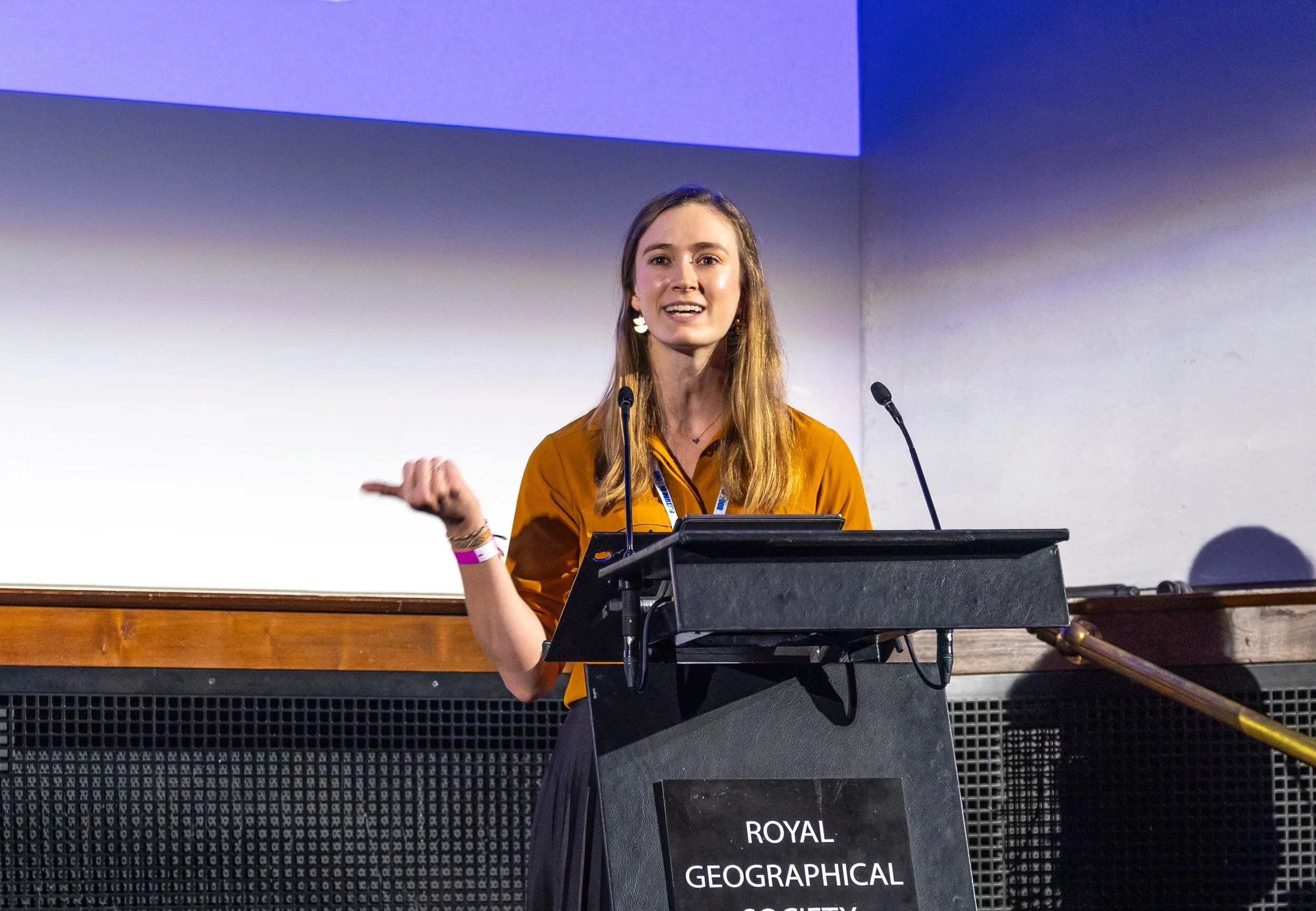
Anna Winter is a Co-founder of Auralytica, a deep-tech startup tackling food security, safety, and waste through next-generation sensing technologies. She is a recent MBA graduate with a concentration in Entrepreneurship, and is a member of Queens’ College. Before founding Auralytica, she worked as a chemical engineer at Johnson Matthey, holding process and project engineering roles across Philadelphia, San Diego, Royston, and London, and contributing to the scale-up and production of a range of industrial technologies. She holds an undergraduate degree in Chemical Engineering from the University of Virginia. Outside of work, she trains with the GB Women’s National Baseball Team and acts as an assistant coach role for their under-18s development squad.