
Redesigning for Impact: Perspectives from the King’s E-Lab Social Venture Residential
Written by Enita Ese Okonkwo
I was lucky to kickstart 2026 with the King's E-Lab Social Venture Residential (SVR) , an immersive experience that explored how social ventures can be designed for impact with ethical intention, systemic awareness and moral responsibility in the development of society.
I have attended several entrepreneurial trainings both within and beyond university, but King’s E-lab was different in that the training focused beyond the technical narratives of entrepreneurship. While it included practical skills for entrepreneurial endeavour, it was also crucially a space of shared learning of innovative perspectives from life to professional experiences. All of these moments challenged us to look beyond outcomes and metrics and ask the more difficult questions: How is value truly created in the business chain? Who benefits and who might be excluded unintentionally? And what responsibilities do social enterprises hold within complex, unequal, and emerging systems with core institutional challenges?
During the residential, it became clear that building ventures for impact may start with the perspective of societal good, but their implementation demands clarity of purpose, systems thinking, and a willingness to confront uncomfortable trade-offs for social sustainability.
Inclusion as Strength: Rethinking Value Creation
One of the business cases that resonated deeply with me during the week was Harry Specters Ltd, a social enterprise that manufactures chocolates while creating meaningful employment for autistic people.
The company itself is innovative in how they frame their business strategy. The frame they use is based on the core strengths of autistic people, namely the efficiency and enjoyability in repetitive tasks. This in turn has influenced the design of their operations and manufacturing processes. Such clarity in focus highlighted that inclusion is a leverage point for changing perspectives while at the same time an opportunity to create optimal systems in business and life. Truly, social innovation is founded on redesigning systems such that strengths, which may have been marginalised, become integrated into value creation for all. When inclusion is integrated in operational design, social and commercial value create a positive loop and this builds resilient ventures.
Social Enterprise as Societal Protection
Equally powerful was learning about HERA UK, founded by Simon Stockley. HERA UK addresses human trafficking by mobilising business networks to prevent exploitation and support survivors. This case reframed how I think about the impacts of social enterprise beyond a vehicle for delivering services because with a broader perspective one can see how social enterprises can function as a form of societal protection in contexts where formal systems may be overstretched or under resourced. Mission-led organisations addressing societal ills can serve as informal yet highly effective layers of accountability and prevention. This raised a deeper question that I have been reflecting on: Can social enterprises act as a complementary governance mechanism by reshaping norms, incentives, and behaviours where policy alone may struggle?
The answer, I believe, lies in how well they understand and engage the systems and people they seek to influence.
Inspired Change for Sustainable Systems
Our sessions with Michelle Fava Darlington on visual thinking and systems mapping were transformative and spoke to exactly how this understanding and engagement might develop. Through drawings, stakeholder maps, and narrative exercises, we learned to visualise complexity before proposing solutions.
Too often, ventures emerge from a desire to “fix” a problem quickly. Working against this trend, systems mapping is a technique that required us to identify feedback loops, power asymmetries, unintended consequences, and leverage points. It reminded us that strategic interventions introduced into complex systems have ripple effects in unpredictable ways.
As an engineer who works at the intersection of infrastructure, sustainability, and development, it was an opportunity to reflect on my work experience which has often prioritised technical solution deployment without sufficient evaluation of system impacts. The residential reminded me that sustainable impact requires understanding environments, incentives, and interdependencies of systems beyond technical performance.
Designing EnviroGuard: Conservation Through Cooperation
During the venture design sprint, my group comprised of 5 others: Rhoda Adjoa Nyarko, Joan Sseggane Nantaba, Jessica Julaia Bouché, Esther Barakengera, and Ivan Tadiwanashe Chuma. Together we tackled potential ideas to support Sustainable Development Goal 15, which focuses on biodiversity protection and preventing species extinction.
Our proposed venture, EnviroGuard, centred on protecting rhino habitats in South Africa through a cooperative model that aligns local communities, government, and tourism operators. We sought to integrate livelihoods, ecosystem protection, and wildlife tourism into a mutually reinforcing model by integrating conservation and economic realities. Communities would not simply be beneficiaries; they would be co-owners and stewards as tourism revenues would support conservation enforcement and habitat regeneration while government actors would provide regulatory alignment and oversight.
The process revealed just how intricate incentive structures can be, as conservation fails when local communities bear costs without receiving benefits and succeeds when stewardship is economically and socially balanced. Designing EnviroGuard required us to think holistically about environmental impacts, power distribution, governance mechanisms, and long-term viability.
Leadership Across Systems
In the middle of the residential, a thought-provoking fireside chat with Imaan Sulaiman-Ibrahim, Honourable Minister of Women Affairs and Social Development of Nigeria, and EMBA student Benedetta Asher encouraged us to think about entrepreneurial leadership across systems. The discussion moved beyond venture design to questions of scale, partnership, and cross-sector collaboration. Leadership, from this perspective, is not about control; it is about alignment that unites public, private, and civil society actors to influence systems collectively rather than optimise isolated interventions.
This lesson resonated strongly as change inspired by transformative leadership rarely succeeds within silos but thrives when incentives, narratives, and partnerships converge.
Redefining Payoff Structures
As the residential concluded, I found myself reflecting on a central theme: social enterprises do not merely operate within systems; they have the potential to redefine them. They do this by reshaping how value is measured, efficiently redistributing benefits, and challenging assumptions about who is and who is not included.
The residential has empowered me to think creatively about how business value is defined and distributed, and intentionally about contributing to the reshaping of payoff structures that allow social enterprises to genuinely thrive in our society.
My gratitude goes to the Mastercard Foundation Scholars Program at the University of Cambridge for their support, and to the team at King’s E-Lab and Cambridge Social Ventures; Kamiar Mohaddes, Sophie Harbour, Nicole Helwig, Neil Stott, Michelle Fava Darlington, Natalie Norouzy, and Maximilian Ge for creating such an impactful learning programme.
The residential was a transformative experience that perfectly synchronised academia, entrepreneurship, and social sustainability. It has inspired and motivated me to lead with purpose, design with intention, and build more responsibly while paying it forward to future generations.
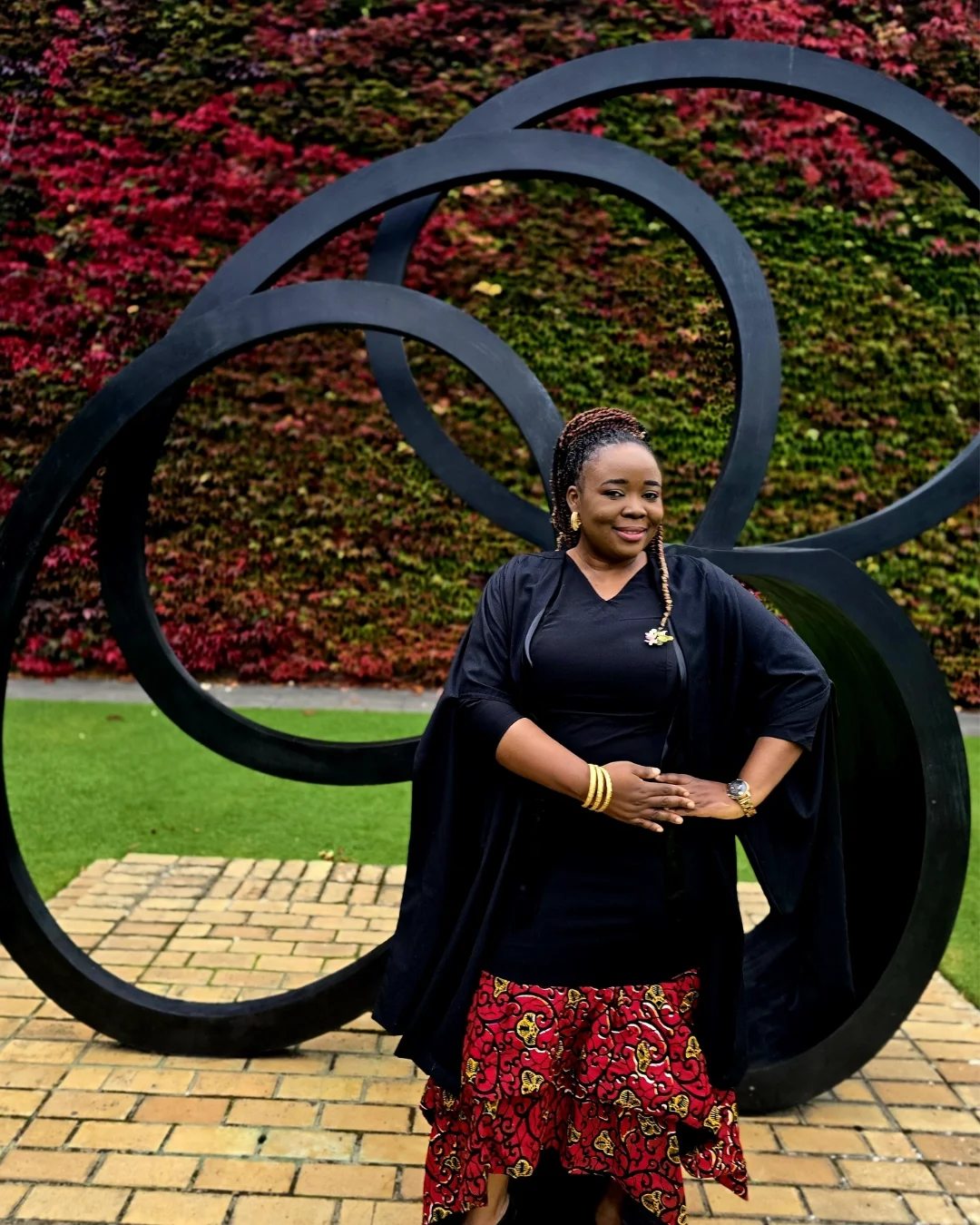
Enita Ese Okonkwo is a Civil Engineer and community builder. She graduated at the top of her class and has 15 years of experience advancing SDG 11 through more than 150 infrastructure projects that have impacted millions across Nigeria. Enita is passionate about climate-resilient infrastructure, entrepreneurship, education equity, and increasing women's participation in STEM. She is the founder of EngineRoom, a construction tech venture promoting sustainability and innovation, and The BookMarket a Meta-verified literacy platform that has distributed over 25,000 books and fostered a social community of 50,000 women and girls.
Enita is currently pursuing an MPhil in Engineering for Sustainable Development in which her research explores integrating Indigenous construction knowledge and smart construction technologies to modernise urban infrastructure development and maintenance in emerging economies like Nigeria.