
How a Non-Tech Team Built LexMentor AI and Won the Clifford Chance Challenge at Hack the Law 2025
Written by VibeLegal (Anh-Dao Dang, Beatrice Furniss, Yousef Sadiq and Sarah Attie)
The legal profession has long relied on the partner-apprentice model, a system where junior lawyers learn through observation, mentorship, and day-to-day feedback. But with remote work, high caseloads, and AI automating much of legal practice, these learning moments are at risk. Our team wanted to help restore them. We built LexMentor AI, an interactive tool that simulates the kind of feedback, support, and skill-building young lawyers traditionally received from busy partners. It offers document reviews, negotiation practice, and firm-style guidance, all powered by AI.
We were not a team of engineers. We were three law students and one business student who came to the Hack the Law Hackathon with no technical background and left having built a working prototype from scratch.
When I first heard about the hackathon, the idea of applying AI to legal practice fascinated me, even though I had little to no technical knowledge. I signed up right away, hoping to contribute legal insight while learning from more technical teammates. Spoiler: we never found those technical teammates.
The first day was full of excitement: meeting brilliant minds, hearing impressive ideas, attending insightful workshops, and searching for teams to join. But as the day ended, a bit of uncertainty began to settle in. Most of the technical participants had already joined teams, and some non-tech students were left wondering, “What now?” We decided to wait and see what the next morning would bring (while everyone else was already preparing). The following day, I found myself in a room with Beatrice, Anh-Dao, and Joe. We looked around, realised no techies were coming, and faced a choice: give up or build it ourselves. We made the decision to build.
Nothing about the process was easy. None of us had a computer science background, and we started planning at noon on the hacking day itself. The hours that followed were stressful, chaotic, and absolutely thrilling. At every moment, we had to troubleshoot unfamiliar tools, align our vision, and prepare a pitch, all under limited time pressure.
But we were never alone. We proactively sought mentors, who kindly offered us helpful feedback, encouraged us to keep going. And our teammates? We supported each other. No one could have done this alone. But together, we built something we were truly proud of.
As a non-technical team, we wanted to make sure we picked a challenge we could genuinely connect with. The Clifford Chance challenge immediately stood out. It asked us to rethink the traditional partner-apprentice model using AI. We brainstormed how we could create something that wasn’t just theoretical, but genuinely useful.
Our LexMentor tool ended up with three key features. First, a document review assistant that allows junior lawyers to upload legal documents for AI-driven analysis. The tool flagged risky clauses and suggested edits, providing just-in-time learning and legal insight. Second, a negotiation simulator with scenario-based prompts and AI-generated feedback based on legal tone, reasoning, and structure, to help users build advocacy and communication skills. And third, a Q&A knowledgebase that mimics internal firm protocols, so that instead of constantly asking a senior associate how to fill in a timesheet or draft a covering email, trainees can query the tool and receive firm-style answers instantly.
We vibe coded each module ourselves, learning everything as we went. Anh-Dao built the first prototype by prompting Google Gemini. Beatrice and I handled the additional tool layers, merging them piece by piece by prompting ChatGPT. Joe, our business brain, kept us on track, challenged our assumptions, and helped shape the product vision, features, and the strategic framing of our pitch.
Our turning point came when we proactively engaged with some of the Clifford Chance team midway through the challenge. Their feedback helped us refine the tool’s user experience and push it further than we thought possible. Anthony, Director of Legal Tech at Clifford Chance said www.besavvy.app, a startup trusted by leading legal teams, developed a tool very similar to ours — we’d essentially independently built something with strong market validation! That support, along with a lot of coffee, kept us going.
When it was time to pitch, Beatrice and Joe presented our tool with clarity and confidence. Hearing them explain that we were a non-tech team who had built an MVP via vibe coding a real highlight. We weren’t sure how the judges would respond, since the competitors were incredibly talented, but we knew we had built something that solved a real problem for junior lawyers, because we were the target users.
Hearing our team name called as one of the Top 10 and then as the winners of the Clifford Chance challenge was unbelievable. To stand alongside incredibly talented teams from around the world was humbling. I had come in expecting to support a tech project. I left having helped build one.
This experience changed how I see law, technology, and what’s possible when you leave your comfort zone. I had never imagined myself interested in coding, but after this hackathon, I have already started learning Python. I now understand that AI is not just for technologists. It is already transforming every corner of legal practice, from commercial law to M&A, arbitration to compliance. More importantly, I believe that lawyers can and should be part of shaping the tools that will define our profession’s future.
To future legal innovators: this is not just a tech event. It is a space where creative minds can experiment, innovate, and improve. I got to meet some of the most talented, inspiring people. You just need to start.
To the Hack the Law team: thank you for making this possible and for organising such a brilliant space for experimentation, learning, and collaboration.
Hack the Law was not just a competition. For me, it was a mindset shift. And yes, I guess I do know how to code now.
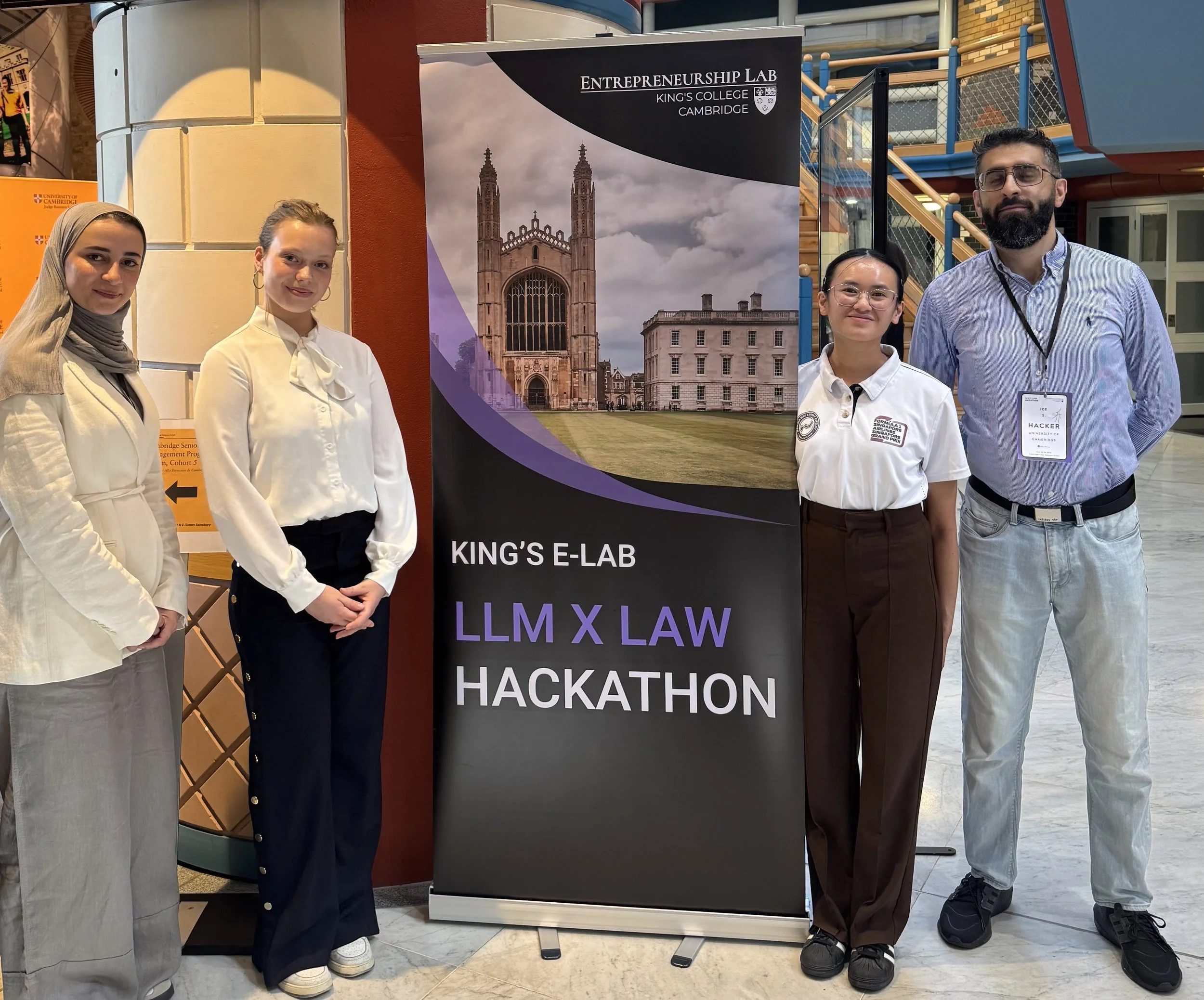
(From the left)
Sarah Attie is a Masters student studying Commercial Law at the University of Edinburgh. She is a licensed lawyer in Saudi Arabia, with prior experience in commercial litigation, corporate governance, and contract negotiations. She is a certified Capital Market Authority (CME-1) holder and has previously volunteered as a projects manager at the Vision 2030 Club. She holds an undergraduate law degree from King Saud University.
Beatrice Furniss is going into her final year as a Bachelor of Laws (LLB) student at the University of Exeter. She has spent the past year working as a part-time legal assistant at WBW Solicitors & Chartered Financial Planners alongside her studies. Previously she was a Commercial Law Intern at the firm Haldanes and marshal at the High Court of Hong Kong. She spent last summer as a LegalTech Intern working with Artificial Intelligence at Emergence AI (a part of Merlyn Mind) in New York city. She also worked as an intern in Biotech Marketing and Supply Chain at Abcam in Cambridge, and in her first year of legal studies completed an Insight Day at Payne Hicks Beach LLP in London.
Anh-Dao Dang is a Master's student studying Economic Law at Sciences Po Paris. She is currently completing a legal traineeship in Corporate and Social Law at PARKER Avocats in Paris and holds a Bachelor’s degree in Finance from the University of Ottawa, Canada. She previously interned at KPMG Canada, first as a Consultant in the Governance, Risk, and Compliance Services practice, and later in the Finance Transformation team. She also gained experience in IT Financial Compliance during an internship at Intact Insurance.
Joe — Yousef Sadiq is a part-time Masters student studying Social Innovation at the University of Cambridge, Judge Business School. With experience in Dubai/UAE, China and the UK, he’s an independent Management Consultant who’s also involved in coaching, and has previously designed and delivered experiential training programmes for international students. He previously worked as an E-Commerce Manager (small startup) and as a Consultant in the Big Four (PwC). He previously read for a BA (Hons) in Chinese and Business and Management at the University of Manchester.