
Slow is Smooth, Smooth is Fast: How Quantum Is Making F1 Races Faster
Written by Chris Tagnon
In the world of Formula 1, where races are won and lost by tenths of a second, every detail counts, and every mistake can trigger irreversible consequences. This is why one of the first pieces of advice given to young drivers honing their craft encourages them to embrace calm and consistency over total aggression: “slow is smooth, and smooth is fast”.
This rationale, which has its merits, is rarely applied to race engineers. They seek to find optimal solutions to various problems as quickly as possible, sweeping the realm of possible outcomes armed with increasing levels of computational power. But imagine trying to plan the perfect race strategy: when to stop for new tyres, what tyres to use, how to respond to the weather or competitors. The number of possible combinations becomes staggering. What if, instead of applying brute force and testing every scenario, they could cool down the problem, literally, and let the laws of quantum physics do the hard work for them?
This is the promise of quantum annealing: a powerful method of solving some of the world’s hardest optimisation problems by mimicking nature’s tendency to settle into its lowest-energy state. It may sound abstract, but it is already being tested in fields ranging from logistics to finance, and soon maybe even motorsport.
What Is Optimisation, and Why Is It Hard?
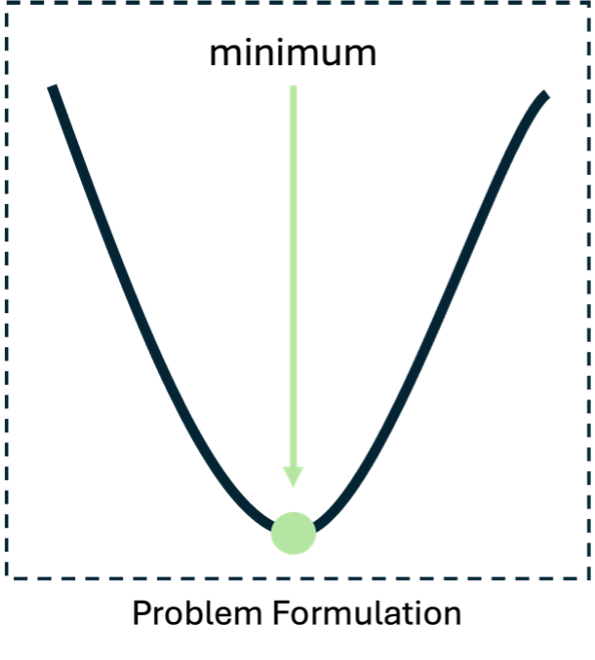
Simply put, solving an optimisation problem consists in finding the minimum of a mathematical function
At its core, an optimisation problem is about making the best choice out of many. Often, this means finding the lowest point in a mathematical function describing the problem.
Crucially, these kinds of problems arise all the time: finding the fastest shipping route, ordering the right amount of stock, or allocating staff shifts to meet fluctuating demand.
The challenge is that the number of possible combinations often grows exponentially with the number of variables involved. Take the example of scheduling pit stops in a Formula 1 race. A team must decide when to stop for new tyres, which tyres to use, and how aggressively to push the car prior to stopping. With just a few variables, a strategist might intuitively consider all possible scenarios. But add weather forecasts, traffic from other drivers, and the odds of the race being interrupted, and the problem becomes significantly more difficult to solve. This kind of problem is known as a “combinatorial optimisation problem”. For each new variable added, the number of possible outcomes multiplies. Very quickly, it can become like searching for a needle in a haystack the size of a galaxy.
Nature’s Shortcut, or Metalwork’s Contribution to Computer Science
Surprisingly, one of the earliest inspirations for solving these tough problems came from metallurgy. When blacksmiths shape metal, they often heat it until it’s malleable and then cool it slowly. If cooled too quickly, the metal locks into a disordered, high-energy structure. But if cooled gradually, atoms have time to settle into a more stable, lower-energy arrangement, yielding the desired shape. This process is known as annealing.
In the 1980s, computer scientists borrowed this idea to develop simulated annealing, an optimisation algorithm which converges to optimal solutions. The algorithm starts by accepting random solutions, classed as “high-energy”, allowing it to explore the landscape of possibilities. It then gradually becomes more selective, choosing lower-energy solutions as the system “cools”, ideally settling into a globally optimal solution.
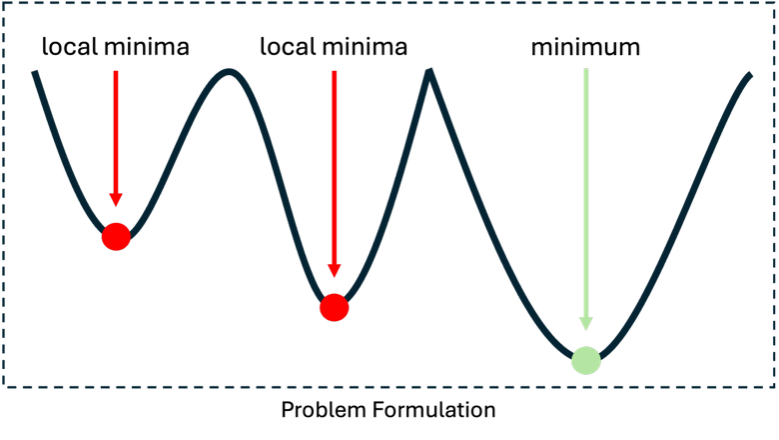
Classical simulated annealing algorithms can get stuck in small valleys, finding local minima instead of the global
This method works well in many cases. But for particularly complex problems, the landscape of possibilities, called the solution space, is rugged and full of “local minima”: valleys that seem optimal in a small area but aren’t the best overall. Once the simulated system settles into one of these valleys, it can get stuck there, never finding the global optimum.
Quantum Annealing: Cutting the Path Even Shorter
Let’s visualise this. Imagine you are blindfolded and placed somewhere in a mountain range. Your task is to find the lowest valley. In classical simulated annealing, you can only feel the slope under your feet and attempt to walk downhill. If you end up in a small valley surrounded by higher peaks, you might assume you have found the bottom, unless you have the time and energy to climb out and try again.
Now imagine you are a quantum particle. Instead of following just one path, you can explore many paths simultaneously. More importantly, you have the quantum ability to tunnel through mountains, popping in and out of valleys without having to climb over the peaks.
This is the core idea behind quantum annealing. It uses quantum mechanical effects, specifically quantum tunnelling and superposition, to allow the system to escape local minima and explore the solution space more efficiently. While a classical computer must evaluate each option one at a time, a quantum system can, in a sense, explore many configurations at once, in a matter of milliseconds.
This doesn’t mean quantum annealing magically solves every problem. But for certain types of optimisation tasks, especially complex ones, it holds real promise.
F1 Strategy as a Quantum Optimisation Problem
Let’s return to the Formula 1 paddock. Teams must design a race strategy before and during the race, adjusting in real time. Hundreds of variables must be considered at all times.
Each of these variables adds a layer of complexity. Factor in their dynamic nature and the number of possible strategies quickly grows into the millions. Traditional simulation techniques would try to explore the tree of options, but they may miss unconventional or counterintuitive strategies that quantum approaches could uncover.
Using quantum annealing, teams can map the quality of each possible solution to a quantum system’s energy states. The system starts in a superposition of all states and slowly evolves, guided by the annealing process, toward the lowest-energy configuration: the optimal strategy. D-Wave Systems, a company pioneering quantum annealing hardware, has already worked on real-world scheduling and logistics problems, proving that these methods aren’t just theoretical.
In racing, milliseconds matter. For teams, leveraging quantum systems to their advantage could be the difference between a podium finish and the anonymity of the midfield.
Quantum Annealing in the Real World
In a business context, milliseconds are replaced by the number of orders delivered on time, the maintaining of optimal stock levels, and maximised staff utilisation. Crucially, milliseconds are replaced by amounts of money saved on the bottom line. The opportunities are nearly endless and spread across many industries.
Modern power grids are highly complex, having to balance energy generation from renewables and traditional sources, as well as fluctuating demand. In 2022 and 2023, the Nuclear Industry Association reported that 7 billion pounds were lost, simply due to energy not being at the right place at the right time. Quantum annealing can be used to determine the most efficient energy distribution strategies, minimising costs.
Coordinating the safe movement of thousands of planes, adjusting for delays, weather, and traffic congestion, is also a significant scheduling problem. While technology has been deployed to assist air traffic controllers, this process is still fairly manual. This leads to potentially avoidable queues and delays. Quantum annealing offers a way to handle the complexity associated with this problem with real-time adaptability.
Supply chain management is a billion-pound optimisation problem for many businesses. This is particularly true for large corporations with exponentially complex supplier networks, for whom even small gains in efficiency would translate to huge economic and environmental benefits. In this field, quantum annealing is proving its ability to thrive where classical methods had previously failed.
These applications are not theoretical. Companies and researchers are actively building prototypes and useable solutions today.
Conclusion: Slow is smooth, smooth is fast
We live in a world awash with complex choices. From your GPS route to work, to the strategy behind a Formula 1 race, or the management of a national energy grid, optimisation is everywhere. And it’s hard. But by turning to quantum principles and learning from the cooling processes of nature, we are beginning to unlock new ways of solving the unsolvable.
Quantum annealing does not promise to replace classical computing, but to augment it, offering a new set of tools to navigate complexity. Like gaining the ability to tunnel through a foggy mountain range, in search of a sheltered valley. If you must only take one thing away from this breakthrough, and most experienced racing drivers will agree, it is this: sometimes, all it takes to speed up is to cool things down.
This essay won the King's John Rose Prize for 'the best explanation of a scientific principle of general interest’.

Chris Tagnon is an engineer and entrepreneur working to bridge the gap between elite high-performance engineering and deep tech venture development. His master’s thesis focused on hybrid quantum reinforcement learning architectures for dynamic optimisation problems. A resident of the E-Lab, Chris has hosted fireside chats with leaders in high-performance engineering, and written on deep tech investment opportunities for the Formula 1 industry. Beyond the track, Chris is the Founder and CEO of CAST Energy, an award-winning start-up developing modular, containerized solar power solutions for humanitarian aid and remote infrastructure. Chris is a two-time Royal Academy of Engineering scholar, and the first Cambridge University student awarded through Sir Lewis Hamilton’s foundation, Mission 44.