
Written by Rosalind Howell
What on earth is a psychology student doing at a business event? This is what I imagined people were thinking as I walked into my first day volunteering on the SPARK incubator with the E-Lab. With limited experience in business, I was somewhat daunted when my first task was to show a team from Tramlines Ventures (a London-based venture capital firm, investor, and venture platform) around the King’s College chapel. Little did I know, however, that I was actually entering the perfect place to learn. Like myself, many of the people on the SPARK incubator programme, which welcomed teams from biosciences, fintech, chemistry, computing and more, were passionate about changing the world in their field but were unsure exactly how to transform their vision into a viable product.
And so, SPARK addresses something that has interested me since I began studying at university: translation between expertise and the markets. We often hear about unsolvable or even “wicked” problems, and it would be easy to despair, believing these headlines. But the reality is not that the solutions do not exist, just that they are struggling to find a foothold in the market. Identifying a solution is only half the battle, and a stumbling block that many revolutionary start-ups meet is not in the idea, it’s in the execution.
The SPARK incubator was designed for people whose experience and expertise gave rise to brilliant innovations, but who don’t yet know how to sell their idea to its fullest potential. A misunderstanding many people have about business is that its greedy and capital focused. Our culture often talks about industry or markets as “selling out” but the E-Lab, and SPARK in particular, take a different view. When done correctly, business can be a vehicle to share scientific and technical breakthroughs which may previously have been held behind the ivory walls of Cambridge laboratories.
The issue is not that the markets exist, but that the right people don’t, or don’t know how to, talk to them. During my time on SPARK, I saw innovations in biomarker monitoring, skincare, and diagnosis. I watched the highly qualified, experienced teams explain their ideas in pitch practice. I saw these teams move from initial collections of ideas and proof of principle, to smooth, considered pitches that were digestible to a wider audience.
But why is this important? To illustrate this, I will use a case study from one of the winners of the SPARK E-Lab prize: Lactosense.
Lactosense is a team developing rapid, at-home testing for mastitis, a condition that affects breastfeeding women, causing pain and difficulty for mothers nursing newborn babies. Led by researchers at the University of Cambridge, the Lactosense team is highly specialised and experienced, having worked in lactation and molecular biology for many years. They continued, however, to hit a persistent stumbling block: developing an MVP. The team pitch was oriented around securing funding to develop this product. They had the expertise and the protocol, and SPARK gave them the final push they needed to develop into a commercially viable product.
SPARK was filled with stories like these. Experts spend years developing solutions to a problem, and in many cases have validated these solutions over the course of their careers. Just because something works, however, doesn’t mean that it will succeed commercially. This is where entrepreneurs in residence and speakers really pushed SPARK to the next level. The founders, with all their diverse expertise, were met by experts in investment, business development, and marketing, all of whom contributed to helping these businesses develop into something with the knowledge and commercial potential to change the world.
As I reflect on my experiences at SPARK, preparing to return to my undergraduate degree, spending hours pouring over lab results and research methods, I feel renewed. It often feels like academic work exists in a silo, isolated from the world. After the weeks I spent at the SPARK incubator, academia feels less isolated. Over the five weeks of the programme, I saw the work of experts in academia and beyond transformed. If innovation continues to follow the example set by SPARK, I believe that the future of technology and industry is bright.
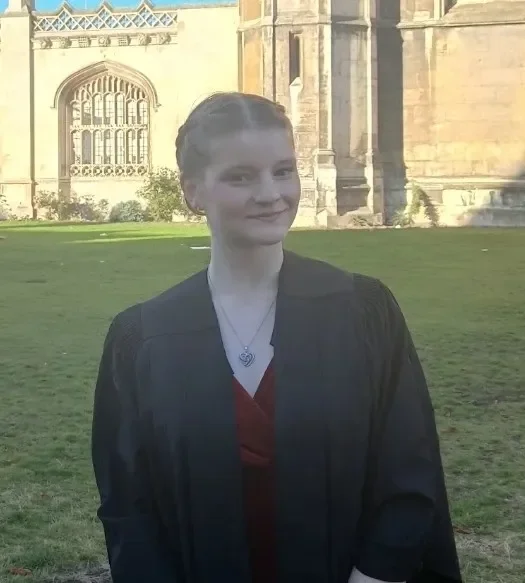
Rosalind Howell is a Laidlaw scholar and PBS student at the University of Cambridge and is a member of Trinity Hall. She is interested in mental health as well as neuroscience and promoting agency in healthcare. These passions have driven her interest in mental health communication and healthcare technology.