
From Technical Founder to Problem-First Company Building
Written by Ruben Ruiz-Mateos Serrano
Polytecks began, like many deeptech companies, with a technology first mindset.
I had just finished building an MVP during my PhD, incorporating the company earlier that year, and stepping out of a purely technical role as a second-time founder, but for the first time as a CEO. My background had always been on the engineering side. I had led development, built systems, and focused on technical execution, but I had never been responsible for shaping a company narrative, raising capital, or systematically understanding a market.
When SPARK 1.0 began, Polytecks was essentially a strong technical idea looking for a problem definition. We had no funding, no structured market analysis, no investor materials, and only a loose understanding of where the first product might sit in the healthcare ecosystem. I knew we were working in bioelectronics and physiological mapping, but I had not yet grounded that in a clear, validated clinical pain point.
That gap became very visible in the first days of the programme.
One of the most formative moments for me was an early session where we were rotated through rapid 20 minute meetings with investors, advisors, and experienced founders. Each interaction required a different framing of the same company. In one conversation I would be asked about technical novelty, in another about clinical relevance, and in another about market size and scalability. I realised very quickly that I did not yet have a coherent answer that tied all of these perspectives together. I was still describing the technology.
What I was missing was the problem.
That shift sounds simple in hindsight, but it fundamentally changed how I approached Polytecks. Up until SPARK, I had been operating in a build first, validate later mindset. SPARK forced the reverse. It made it clear that technical capability is only meaningful when it is anchored to a clearly defined and urgent problem.
For Polytecks, that meant rethinking everything from the ground up.
Our first product, SwiftStage, is focused on enabling earlier diagnosis of mitral valve disease in dogs, one of the most common cardiac conditions in veterinary practice, affecting a large proportion of ageing dogs seen in primary care. The clinical reality is that diagnosis often depends on access to specialist equipment such as echocardiography, which is not widely available in general practice. That creates a bottleneck where disease is often detected later than ideal.
Reframing the company around this specific pain point, rather than around our sensing and modelling capabilities, became a turning point.
SPARK was also the point where Polytecks became a company in the true sense of the word, rather than just a technical project. I met my co-founder during the programme, and we began working together shortly after. That partnership fundamentally changed the trajectory of the company. It introduced a balance between technical development and commercial thinking that I had previously been missing.
The environment around SPARK also played a major role. Being embedded within King’s E-Lab, living in college during the programme, and working closely with other founders created a level of intensity that is difficult to replicate elsewhere. The ecosystem felt less like a structured programme and more like a shared working environment where everyone was actively building, testing, and iterating in real time. That proximity to other teams and mentors made the process significantly more practical. Problems were not theoretical. They were immediate and shared.
The sessions with founders and investors were particularly important in that regard. They were not polished narratives of success, but direct accounts of failure, iteration, and misjudgement. That honesty forced a recalibration in how I thought about execution. It became clear that overplanning is often a substitute for engaging with reality.
SPARK also had concrete outcomes for Polytecks. We secured early validation through investor conversations, received a £20k SAFE investment from Cambridge Enterprise Ventures, and began building a network of clinical and commercial advisors that we continue to work with today. More importantly, we left the programme with a much clearer understanding of how to position the company, not just describe the technology.
Since SPARK, the trajectory of Polytecks has shifted significantly. We now have defined product direction, early-stage funding, expanded intellectual property, and have begun a multi-site veterinary study to validate SwiftStage in clinical settings. We have also started our pre-seed fundraising process and are engaging with investors from a much stronger position.
The most important change, however, is not structural but conceptual.
SPARK forced a transition from explaining the technology to articulating the problem. That shift has shaped every decision since.
For founders coming from technical backgrounds, especially within research environments like Cambridge, it is easy to believe that technical depth is the primary differentiator. In reality, technical depth only becomes meaningful when it is directed by a clear understanding of user pain and real-world constraints.
King’s E-Lab, through SPARK and beyond, has been key to that realisation. It has not only provided access to mentors, investors, and funding opportunities, but also a community that continuously reinforces the realities of early company building. The support has extended beyond the programme itself, through competitions, events, and ongoing engagement that makes it feel less like an accelerator and more like a long-term ecosystem.
Polytecks is still early, but SPARK was the point where it became grounded in a real problem rather than a technical possibility. That distinction has made all the difference.
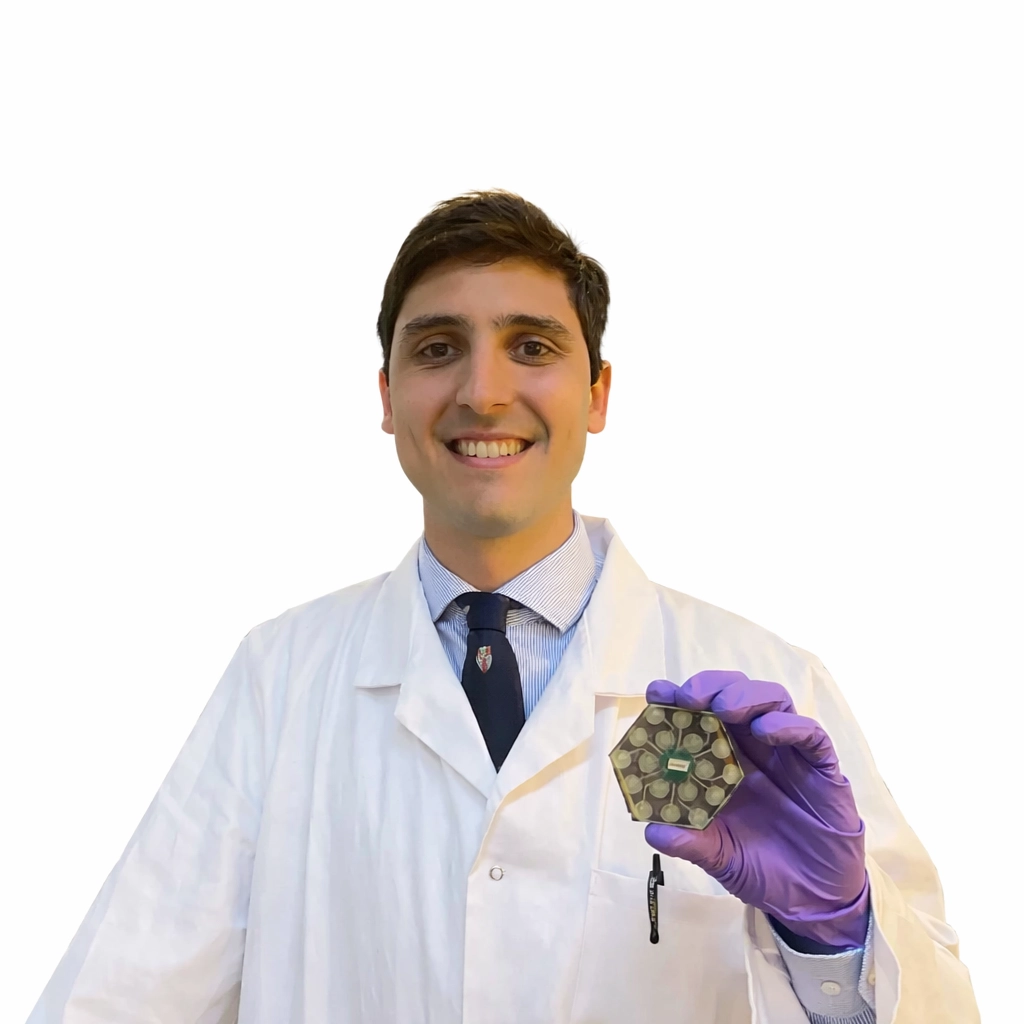
Ruben Ruiz-Mateos Serrano is a biomedical engineer, entrepreneur, and former researcher working at the intersection of bioelectronics, wearable sensing, and machine learning. Before starting his PhD in Engineering at the University of Cambridge, he co-founded Qtrace, an AI-driven startup focused on fish quality assessment and supply-chain transparency in the seafood industry. During his doctoral research, he developed high-density bioelectrical sensing technologies using flexible electronics and conducting polymers, work that became the foundation of Polytecks, a Cambridge-based deep-tech company where he now serves as Co-Founder and CEO. Polytecks is developing wearable bioelectronic sensing systems for rapid, non-invasive diagnostics in veterinary and human healthcare, with a mission to make advanced physiological measurement more accessible, scalable, and clinically actionable.