
Quinn: Keeping Lawyers Across the Facts When Cases Move Fast
Written by Team Quinn (Amelie Sluiter, Annika Koch, Igor Lima Rocha Azevedo, and Leonardo Wink)
There is a moment at every hackathon when an idea stops feeling abstract and starts feeling real. For Team Quinn, that moment happened on a Friday evening in Cambridge, in a conversation with Robert Clay from Clifford Chance.
We had arrived at the Hack The Law hackathon as two separate groups who had never met. Amelie and Annika came from the legal tech initiative recode.law with legal backgrounds. Igor and Leonardo came from Imperial College London, one finishing an MRes in AI and the other an MSc in Computing. We found each other during the pre-hackathon networking, and the connection was immediate. But it was Robert's description of what it actually feels like to manage a fast-moving caseload that gave us our direction: the constant flood of new documents, the fear of missing something significant, the expertise that walks out the door when a lawyer rolls off a case.
What struck us about that conversation was how little of the current legal tech landscape is actually built for that experience. Most tools are aimed at the person doing the work, the junior associate drafting the memo, the paralegal reviewing the contract.
But the partner overseeing a complex matter, trying to stay across rapidly evolving facts while supervising a team and managing client expectations, has almost nothing built for them. That felt like a real gap, and we committed to it. The four of us spent the rest of the evening bouncing ideas around, and by the time we went to bed we had the broad outline of what Quinn could be.
The Problem Quinn Solves
Today, every legal matter is essentially a temporary silo. Documents, emails, research, and human expertise accumulate over months and then largely disappear when the matter closes. Lawyers working on an active case face a particular version of this problem: new material lands constantly, and staying across rapidly evolving facts, issues, and evidence is genuinely hard, especially on complex, high-volume cases.
Quinn addresses this head-on. At its core, Quinn flags anomalies as new material arrives in an ongoing matter, helping lawyers notice what has changed and why it matters. But beneath that lies something more ambitious: a living knowledge base of the matter itself, one that tracks what AI generated versus what humans verified, coordinates work across the legal team, and supervises how legal work actually gets done. Lawyers can also query the entire matter file through a chat interface, getting instant answers to case questions or drafting client updates in seconds.
We were never trying to build the next Harvey or Legora. Instead, we were trying to build the system of record for legal work itself: supervising, provenance, verification, task orchestration, and matter management in one place.
A Focused Saturday and a Near-Disaster
Saturday was heads down. Leo and Igor drove the technical build, working with Claude
Code, Neo4j and Perplexity to bring Quinn to life, while Amelie and Annika kept testing the tool, challenging features from a legal perspective, and making sure the product actually made sense for the lawyers who would use it. The division felt natural almost immediately: the tech side could build fast, but it was the legal side that knew which features actually mattered and which outputs would land well with a practitioner. It went both ways too: the engineers kept pushing back on what was technically feasible, which forced the legal side to sharpen their thinking about what mattered most.
By early evening, though, we hit a wall. Our deployment took far longer than expected, and with the 9pm submission deadline approaching, we suddenly had very little time left for the demo, the pitch slides, and the submission form. What we handed in was rougher than we would have liked, but it was in.
After the deadline, we celebrated with drinks at the University building before heading to a local pub to watch England's World Cup match. It was the perfect way to end an intense day.
Sunday: Improvisation and a Grand Finale Spot
Sunday morning brought a first-round pitch with almost no preparation time. We improvised. Somehow, it went better than our polished attempts might have. The judges saw something in Quinn, and we were announced as one of the ten teams selected for the Grand Finale, which was equal parts thrilling and terrifying. Pitching in front of the full audience, with judges from leading law firms, tech companies, and universities, is a different experience from a small room. Nerves were real. But we had spent. the whole weekend talking about this problem, and by that point we could speak to it fluently.
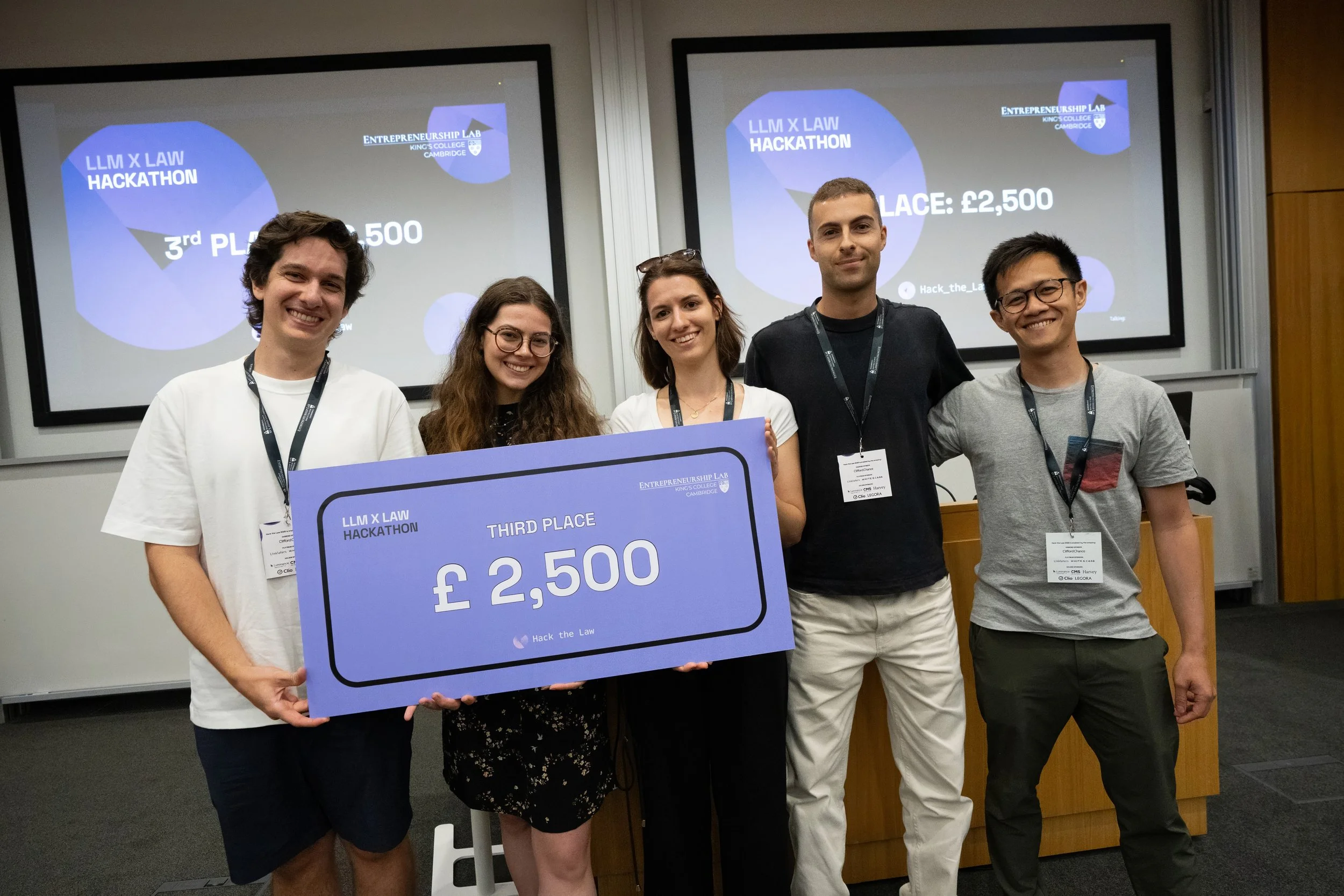
When the final results were announced, Team Quinn had placed third overall and had also won the challenge prize for best use of Perplexity. We genuinely had not expected either.
What Made the Weekend
Winning 3rd place was wonderful, but looking back, what made the hackathon was the
collision of different kinds of knowledge in a single team. Legal professionals know which problems are worth solving and can sense immediately when a tool does not quite fit how lawyers actually work. Engineers know how to build fast and think carefully about architecture. Neither is enough on its own. So if you are coming as a lawyer who has never touched a line of code, or an engineer who has never set foot in a courtroom, do not let that put you off. That gap between you and your teammates is not a weakness. It’s the whole point. It is also worth saying that this was Amelie and Annika's first hackathon. If you have never attended one and are not sure whether it is for you, the answer is almost certainly yes.
For anyone considering Hack The Law next year: come with an open mind about your team, get to know other participants and pay attention to how you connect with people on a personal level. You will spend an intense stretch of time together, handle stressful moments together, and have to trust each other when things do not go to plan. And do not worry if you arrive without a fully formed idea. What matters is finding a problem you care enough about to commit to. The solution will change shape as you build, and that is exactly how it should be. The best thing that happened to us was a Friday evening conversation with strangers that turned into Quinn.
Amelie Sluiter is the Vice-Chairwoman of recode.law, a non-profit organization dedicated to driving innovation and education at the intersection of law and technology. Her background is in compliance, having gained practical experience providing data protection counsel across various firms before transitioning into advanced tech research. Now a researcher at an institute for secure information technology, she is currently pursuing her PhD with a focus on AI regulation, focusing on how policy can safely accelerate and support AI adoption rather than halt its advancement.
Annika Koch is a member and former chairwoman of recode.law. Having studied law at the University of Münster and European Legal Studies at the University of Turin, she specialises in IT and IP law, with a particular focus on AI regulation and EU copyright. She currently divides her time between the European AI Office and a research project developing an experimental generative language model tailored for the German judiciary. Closely following developments in the legal market, she is passionate about evaluating legal AI tools and educating students and professionals on the future of the industry.
Igor Lima Rocha Azevedo is an MRes candidate in Artificial Intelligence at Imperial College London. His research journey spans three continents, beginning with a first-class degree in Electrical Engineering in Brazil, where he was awarded the Brazilian Government Scientific Initiation Scholarship for his work on FPGA-based security architectures. He later served as a Research Scholar at The University of Tokyo under the prestigious MEXT scholarship sponsored by the Japanese Government, collaborating with Nikkei Inc. to develop large-scale news recommender systems and foundational LLMs, a body of work that earned him a SIAM Travel Award at the SDM'25 conference. Currently, his research focuses on generative and contrastive deep learning to predict rare clinical events in large-scale healthcare data.
Leonardo Wink is an MSc Computing student at Imperial College London, where his research focuses on optimising inference for periodic agentic systems, specifically reducing redundant computation when agents re-run on largely unchanged context. He came from a finance background, taught himself to code, and shipped a financial analysis text interpretation engine at a startup before transitioning fully into computer science. He is particularly interested in building AI solutions that solve real-world problems at the intersection of technology and other domains.