
Reflections on The American Dream and Other Fairy Tales: A Screening and Q&A with Abigail Disney
Written by Freddie Fineman
To close each Thursday Speaker Series event, the E-Lab gives out a few copies of the speaker’s recommended book to the ‘best’ questions during the Q&A: often chosen by the speaker themselves. After this particular event, a screening of Abigail Disney’s documentary ‘The American Dream and Other Fairy Tales’, I had the great opportunity to ask Abigail about the book she had chosen: George Eliot’s Middlemarch. Coincidentally, this was the first piece of literature that I wrote about when I first came to Cambridge.
Having once been an English Literature student herself, Abigail told me that she had always enjoyed Eliot’s writing for her ability to draw the reader into such intimate proximity with each character, how she was able to create a strong and enduring familiarity between reader and character.
This speaks to, in many ways, an understanding of Abigail’s work, hence why it felt appropriate to start my reflections on the event with this choice of book. Abigail begins with and works outwards from the individual. For ‘The American Dream and Other Fairy Tales’ that individual is Ralph, a long-term employee at the Disneyland resort in Anaheim, California. The documentary, which emerged as a result of his appeal, follows him and his wife, Tina, amongst others, who all struggle to earn basic liveable wages whilst full-time employees of The Walt Disney Company.
By focusing on a select few individuals, the documentary is able to ground those who watch it in the specific day-to-day reality of someone else’s life. Ralph allows us, through the medium of film, to enter his home and meet his family. There is an intimacy there that cannot be matched in other mediums of communication. Abigail could have commissioned an independent report on the mitigatable challenges facing Disney’s park employees, and yet she chose film. By giving us a face and a story, the viewer is forced to acknowledge that there is a person behind every statistic. It empowers you to think through your heart and to consider your own circumstances alongside those of others in a way that fosters a very personal understanding, unique to each viewer. For example, I may not be American or work for Disney, but I care deeply about my family and seeing Ralph’s family made me ask what I would do in that position? Abigail’s discussion following the film, however, reminded me that I don’t actually have to be in Ralph’s position to act. What matters is how I act right now, locally.
Another thing I discussed with Abigail that really stuck with me was the need to slow down. Reading, and particularly reading a piece of literature as intricately woven as Middlemarch, requires you to slow down. Abigail stressed over the speed at which our world moves, so quickly that we rarely have time to stop and look around, to pay due attention to lives of others, their struggles and aspirations. The experience of watching the documentary worked in a similar way. For me, it was particularly powerful for a room full of people to come together and allow themselves to step away from the bustle of their own lives, to slow down and immerse themselves, even if just for those few hours, in the lives of others.
Time then emerges at the heart of the documentary. And this is for more than just its ability to slow viewers down for a moment.
For Abigail, time is a funny thing. She says that ‘Having the last name Disney is like having a weird superpower you didn’t ask for’. People will listen to you and give you their time. Being a Disney also comes with the privilege of being a recipient of a rather large family fortune. Where Abigail stands out amongst America’s very high-net-worth individuals, however, is that she has used the time that this has given her to work on and develop the documentary (and the broader project that it sits within). For some, this may seem a more subtle and quiet resistance to any corruptions in larger corporations, but commitment to it nonetheless takes a certain strength.
For the workers at the Disney parks, it is their time that they are exploited for – it is what they also lose out on with their families as a result of having to work extra hours or take on multiple roles to put food on the table they ultimately struggle to get home to. And then to go out and advocate for yourself and others subjected to the same treatment is where the greatest display of strength is to be observed – yet still it takes more time.
This borderline exploitation is what Abigail has been speaking out about for years. In 2019 she described the pay of the company’s then-CEO Bob Iger, which stood at 1,424x that of the median Disney employee, as ‘insane’. And this documentary was a chance to show the human side of this sum.
The suggestion that the call for liveable wages is radical, or even socialist, as Abigail laughably recounted being dubbed at the close of questions, goes to show how entrenched money-hungry disregard for human life is. The documentary very simply bares the reality as it is: people are more than just workers and they are suffering.
I am also deliberate when I write ‘the’ documentary rather than ‘her’ documentary. While Abigail was very much the leading force in this project, she was also just a facilitator. She made space to share, through the medium of film, the stories which belong to those bearing the weight of the USA’s ever expanding wealth gap.
As the evening drew to close, I was left asking myself: what is Disney? And who is Disney? From what I saw and heard that night, Disney is a family. Not determined by name, but by community. It’s Ralph, and all those workers at the parks who are still fighting to feed, care, and be present for one another when no one else will. As I begin my Leadership in Action project at a local Cambridge charity this summer, I hope to carry with me the humanity and courage to push for social justice that this Disney worker community shows and to bring this spirit to my local level.
But the bottom line is, no family, be it blood or community, should have to exist like this.‘The American Dream and Other Fairy Tales’ is a title made all the more poignant by comedian George Carlin’s words: "It's called the American Dream, because you have to be asleep to believe it." Slowly, it seems, people are waking up.
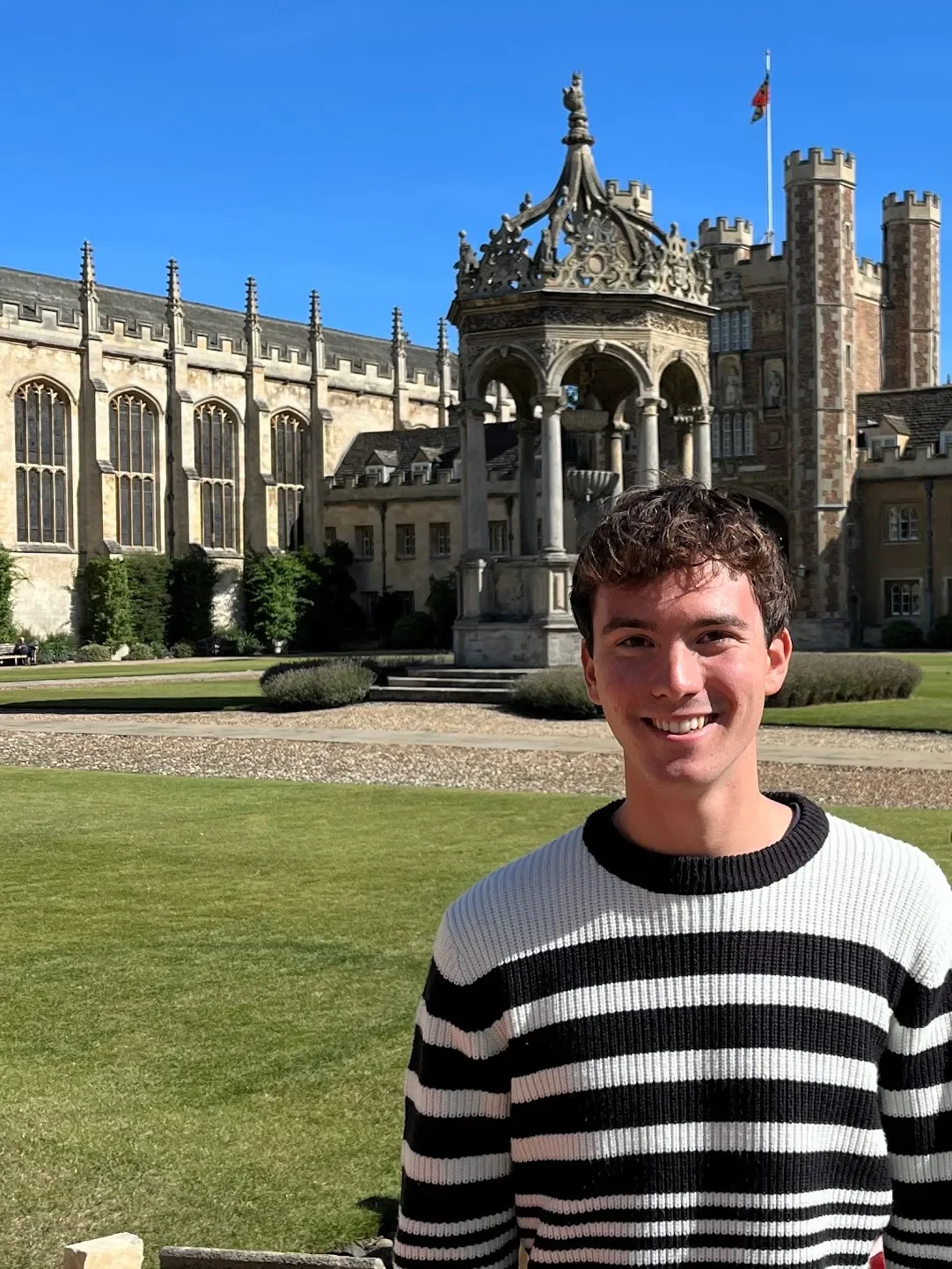
Freddie Fineman is an undergraduate student in English at King’s College, Cambridge. He is passionate about public engagement with the arts and utilising them to further the democratisation of knowledge beyond academically and institutionally exclusive spaces. He has worked on multiple projects that have evaluated and implemented
strategies for participation and accessibility in both East Anglia and the South West. Freddie seeks to apply his experience through his research into methods of supporting literacy engagement and outcomes for young people in rural areas.